

World Cervical Cancer Prevention Week
- 23 January 2026
-
 930
930


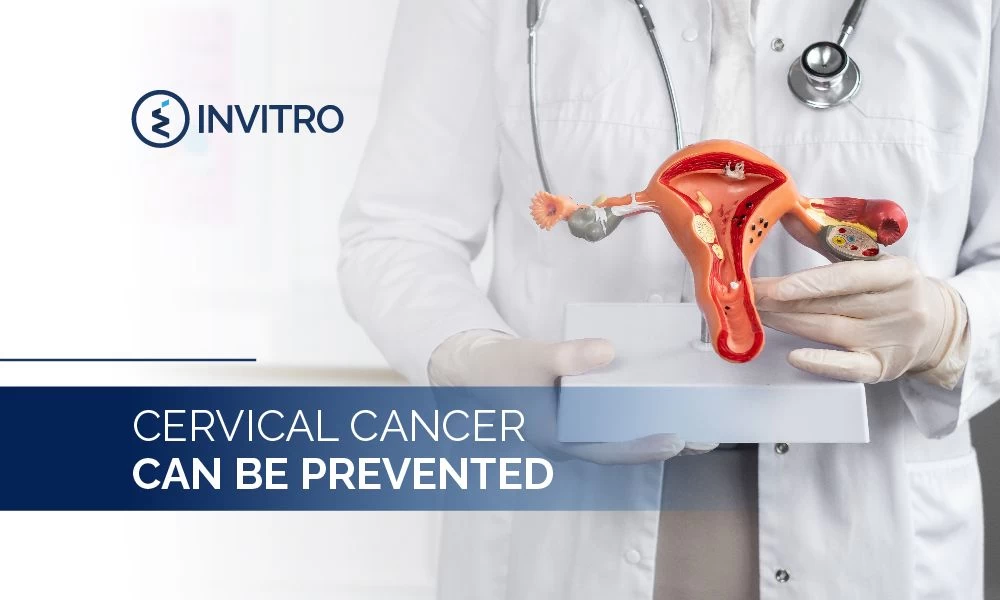

Why early diagnosis can save lives
Every year worldwide, World Cervical Cancer Prevention Week is held - an international initiative aimed at raising awareness about the disease and its early diagnosis.
Cervical cancer is one of the few oncological diseases whose development can be prevented through timely screening using laboratory tests such as the Pap test and the HPV test.
Despite the availability of effective detection methods, the disease remains a serious problem in many countries. The main reasons are late diagnosis, insufficient awareness, and irregular participation in preventive examinations.
What is cervical cancer
Cervical cancer is a malignant disease of the female reproductive system that arises from cells of the cervical epithelium.
Most often, the disease develops gradually: first, precancerous changes in cells form, which may persist for several years. In the absence of timely detection and treatment, they can progress into a malignant tumor.
A feature of the disease is its asymptomatic course in the early stages, so regular screening plays a key role.
Symptoms of the disease
At later stages, cervical cancer may manifest with:
- bleeding outside of the menstrual cycle
- bleeding after sexual intercourse
- unusual vaginal discharge
- pain in the pelvic area or lower abdomen
At the appearance of such symptoms, it is important to see a doctor as soon as possible.
Statistics: global situation
According to the World Health Organization (WHO), cervical cancer remains one of the most common causes of cancer mortality among women. [1]
According to the latest estimates:
- in 2022, about 660,000 new cases were registered worldwide
- about 350,000 women died from cervical cancer
- the disease ranks fourth among the most common cancers in women
More than 90% of deaths occur in low- and middle-income countries where prevention and early diagnosis programs are less accessible. Meanwhile, in countries where vaccination and screening programs have been actively introduced, there has been a significant reduction in incidence. For example:
- in Scandinavian countries, mortality has decreased by more than 70% thanks to regular cytological screening; [2]
- Australia may become the first country in the world where cervical cancer is virtually eliminated as a public health problem thanks to vaccination and screening. [3]
Global goal: elimination of cervical cancer
In 2020, the World Health Organization announced a global strategy to eliminate cervical cancer as a public health problem.
By 2030, the following goals are planned:
- 90% of girls should be vaccinated against HPV
- 70% of women should be screened at least twice in their lifetime
- 90% of women with identified disease should receive treatment
Human papillomavirus - main cause of the disease
The main risk factor is the human papillomavirus (HPV), which includes more than 200 types.
- Low oncogenic risk: skin warts, papillomas, genital condylomas (HPV 6 and 11)
- High oncogenic risk: precancerous changes and cervical cancer (HPV 16, 18, 31, 33, 45, 52, 58)
HPV often occurs without symptoms, especially oncogenic types, so timely screening is extremely important.
HPV 16 and HPV 18 are responsible for approximately 70% of cervical cancer cases worldwide.
In addition to cervical cancer, some types of HPV may be associated with the development of:
- anal cancer
- oropharyngeal cancer
- penile cancer
- other tumors of the anogenital area
How HPV can be transmitted
The main route of transmission is contact of skin or mucous membranes with an infected area.
The most common methods of transmission include:
Sexual contact - the virus can be transmitted during vaginal, anal, or oral contact.
Skin‑to‑skin contact - the virus can be transmitted even with close contact in the intimate area without full sexual intercourse.
Transmission from mother to child
In rare cases, the virus can be transmitted to the child during childbirth.
It is important to understand that the use of barrier contraception reduces the risk of infection but does not provide 100% protection.
How the virus behaves in the body
After entering the body, the virus infects epithelial cells of the skin or mucous membranes. Three scenarios are possible:
Spontaneous disappearance - the immune system suppresses the virus, usually within 1–2 years.
Persistence - the virus remains in the cells for a long time without symptoms.
Development of cellular changes - with prolonged presence of oncogenic types, precancerous changes form that can progress to cancer. This process develops slowly - over several years or even decades, which allows pathology to be detected at an early stage through screening.
Pap test: history and significance
The name “Pap test” comes from the surname of Georgios Papanicolaou, who in the 1940s proposed a method of cytological examination of cervical cells for early detection of precancerous changes.
The full name of the procedure is “cytological smear according to Papanicolaou.”
The method became revolutionary in women’s medicine because it made it possible to early diagnose precancerous and early cancerous changes and significantly reduce mortality from cervical cancer.
The Pap test allows detection of:
- early cellular changes
- precancerous conditions
- inflammatory processes
When changes are detected at an early stage, treatment is usually less traumatic and significantly more effective.
When and how often you should have a Pap test
- Up to 21 years old — screening is generally not performed
- 21–29 years old — Pap test every 3 years
- 30–65 years old — Pap test every 3 years, HPV test every 5 years, or combined screening every 5 years (most informative)
- After 65 years old — screening may be discontinued if previous results were normal and there is no history of serious precancerous changes; the decision is individual
Types of cells according to Pap test results
- NILM (normal result) — cells are normal
- ASC‑US — atypical cells of undetermined significance, more often inflammatory
- LSIL — mild precancerous changes, sometimes disappear spontaneously
- HSIL — significant precancerous changes, require additional examination
- Suspicion of cancer — requires urgent diagnostics
Conducting the analysis
For the Pap test, a smear is taken from the cervix; for other studies, venous blood is taken.
- The procedure is performed by a medical specialist according to safety standards
- Material collection takes only a few minutes and is generally well tolerated
- The material is examined using modern methods to identify cellular changes or specific IgE
The results help the doctor determine precancerous changes and assess clinical risk to select the optimal observation or treatment strategy.
Screening at “Invitro Diagnostics”
We carry out comprehensive cervical cancer screening:
- Pap test in liquid medium - a modern and accurate method
- HPV test - determination of oncogenic types
Our gynecologist specialists help:
- interpret results
- give recommendations for observation and prevention
Detailed instructions on preparation for tests can be found in their description on the website.
Take care of your health
Regular examinations preserve health and reduce the risk of complications.
Cervical cancer can be prevented through timely screening and laboratory monitoring.
Make an appointment for a preventive test or a consultation with our gynecologist and gain access to full information about your health.
Take care of your health.
Appointment: 078 903 999 - call or message.
Sources:
1) https://www.who.int/news-room/fact-sheets/detail/cervical-cancer
2) https://pubmed.ncbi.nlm.nih.gov/29778519/
3) https://www.who.int/news/item/17-11-2023-investing-in-cervical-cancer-elimination-across-australia-and-the-indo-pacific